
Ireland's Underwater Meadows
Introduction
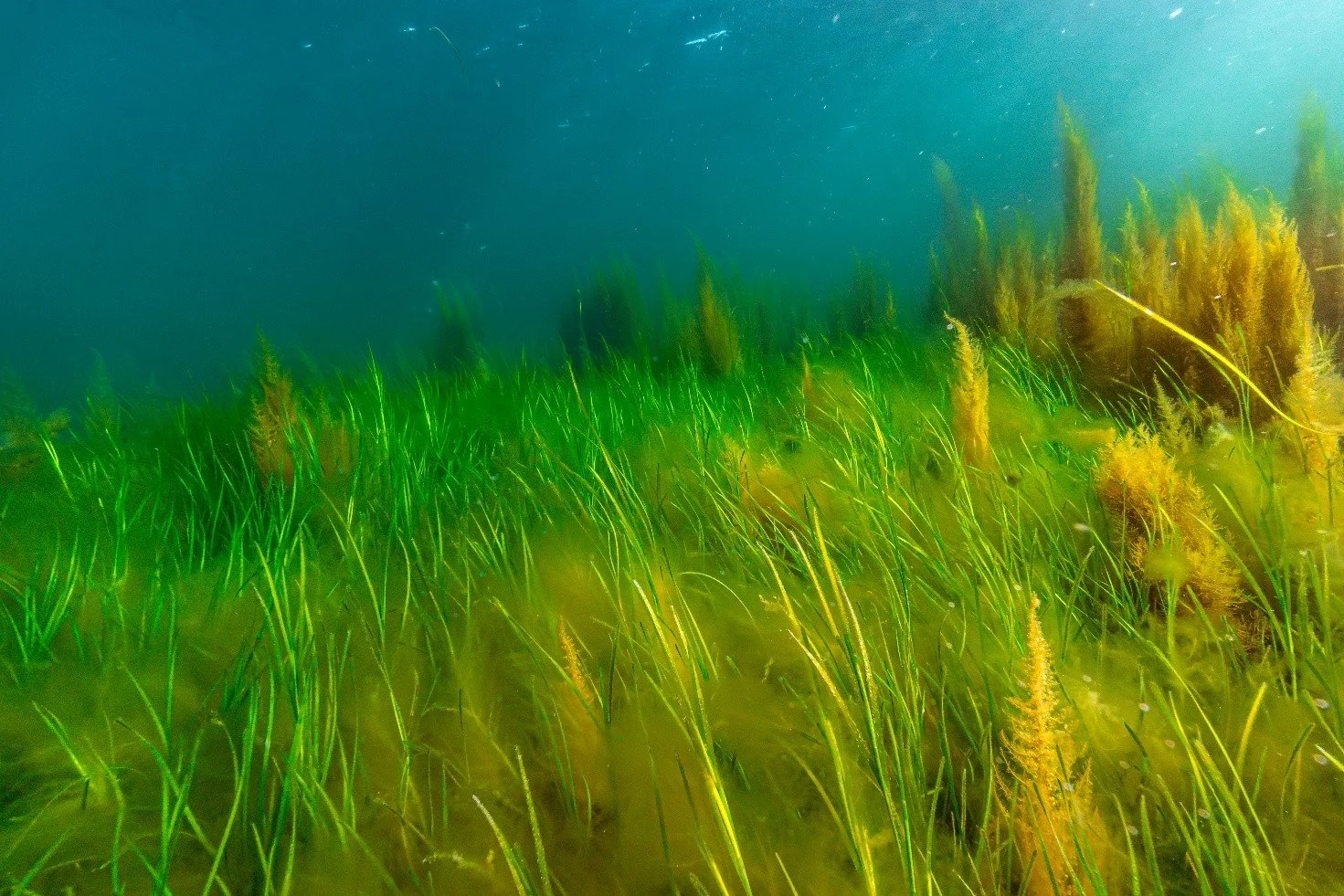
This month we are taking a look at a group close to my own heart – seagrass! You may have heard a lot about seagrass more recently in the media as it becomes an increasingly valued group of species, and for good reason. Seagrass plays a vital role in protecting our coastlines, storing carbon, and supporting countless species' life cycles. As a diver, both in Ireland and beyond, diving seagrass meadows, or areas where seagrass is present, can allow us to see a huge diversity of species. In warmer waters from sharks, rays, sea turtles, all manner of fish species – hammerhead sharks have even been studied eating seagrass. Irish seagrass meadows are no different. Dive into what seagrass is, why it's important, how we can protect it, and what we can see beneath the waves.
What is seagrass?
At first glance seagrass may seem similar to seaweed, and in some ways it is – both are groups of species that photosynthesise and live in our oceans. In fact, seagrass and seaweed are very different groups. Seaweeds are algae, and you can read about kelps in the article “Dublin's Premier Underwater Reef Former” that I wrote on the Oceandivers website. Algae are quite different from angiosperms, or flowering plants, both in their ancestry and how they reproduce. Seagrasses are marine angiosperms, and are more closely related to flowering plants on land than they are to seaweeds. It is quite straightforward to identify if you are looking at seagrasses in Ireland because, well, they look very similar to grasses on land. They are the only flowering plants that are fully marine.
Seagrasses have evolved across four separate groups of flowering plants. In Ireland, two species, Zostera marina, and Zostera noltii, are the most abundant. Zostera marina, commonly referred to as eelgrass, is a medium-sized seagrass that grows in the lower intertidal and subtidal zones, whereas Zostera noltii is mainly an intertidal species growing higher up on the shore [1]. Seagrasses across the four groups have a worldwide distribution in tidal zones, with the exception of the Antarctic. Wherever you are diving in the world, there is a good chance that seagrass is on the cards for your underwater visit.
The structure of seagrass is also, as you would expect, similar to their land-based relatives. They have a root system which extends from their rhizomes, and out above into their blades. The older an individual is, the more “leaves” they will produce, although older ones will break off as they become older as well.
What is Seagrass Important For?
So, why is seagrass so important, and why has it been so discussed recently in the media? Globally, seagrasses provide a wide range of services to the ecosystems they are found in. These often vary between locations and also may be species-specific. Particularly, eelgrass meadows, due to their variations in size, age, and density, can vary a lot in the different services they provide [2],[3]. Seagrass meadows can take carbon from the water around them and store it in the sediments below them, much like how land plants do this. On land this stored carbon is called green carbon, whereas in the water it is blue carbon. In addition to this, seagrasses can lessen the impact of waves and surge in the area, prevent sediment from being suspended in the water, and provide food, shelter, and safe nurseries for young fish. Globally, seagrasses are a really good indicator of the health of an ecosystem [2]. Because of these functions, diving around seagrass meadows can be an opportunity to see young fish of many different species, and potential predators of them.
Threats and what we can do
A wide range of disturbances are globally impacting seagrasses, including climate change, fisheries activities, and construction activities [4],[5], and these disturbances are causing large declines in seagrass populations worldwide [2]. We do not yet know just how important these meadows are in blue carbon storage because there has been such a gap in research on coastal blue carbon. This is important for fishing too, because of how important these meadows are for juvenile fish species [2]. That is why now more than ever, it is vital that we value and protect our underwater grasslands, and this starts with us divers as ambassadors for the underwater world.
There are a number of projects surrounding seagrass currently happening in Ireland – from projects with Seasearch Ireland, Coastwatch Ireland, the Environmental Protection Agency, and lots of Universities, to name a few!
Diving the Meadows
Next time you are diving with seagrasses in Ireland and beyond, have a look at the smaller species taking shelter in and around the meadows, and watch how the flow of the water moves across these ecosystems. You can find seagrasses all around our coast, particularly on the west coast, with mapping efforts actively working to catalogue our meadows as we speak.
Make sure not to pull at the seagrass, and improve your buoyancy to ensure you do not kick up these meadows when you are diving over them.
Next March 1st, on world seagrass day, make sure you get out into the ocean if you can to see these amazing ecosystems – there is more to see than you might think
References
Photo by Daniel Fildes; https://dfwild.com/ , @dfwild
1. Beca-Carretero, P., Azcárate-García, T., Julia-Miralles, M., Stanschewski, C. S., Guihéneuf, F., & Stengel, D. B. (2021). Seasonal acclimation modulates the impacts of simulated warming and light reduction on temperate seagrass productivity and biochemical composition. Frontiers in Marine Science, 8, 731152 https://doi.org/10.3389/fmars.2021.731152
2. Orth, R. J., Carruthers, T. J. B., Dennison, W. C., Duarte, C. M., Fourqurean, J. W., Heck, K. L., Hughes, A. R., Kendrick, G. A., Kenworthy, W. J., Olyarnik, S., Short, F. T., Waycott, M., & Williams, S. L. (2006). A global crisis for seagrass ecosystems. BioScience, 56(12), 987 996. https://doi.org/10.1641/0006-3568(2006)56[987:AGCFSE]2.0.CO;2
3. Nordlund, L. M., Jackson, E. L., Nakaoka, M., Samper-Villarreal, J., Beca-Carretero, P., & Creed, J. C. (2018). Seagrass ecosystem services – What’s next? Marine Pollution Bulletin, 134, 145–151. https://doi.org/10.1016/j.marpolbul.2017.09.014
4. Marbà, N., & Duarte, C. M. (1997). Interannual changes in seagrass (Posidonia oceanica) growth and environmental change in the Spanish Mediterranean littoral zone. Limnology and Oceanography, 42(5), 800–810. https://doi.org/10.4319/lo.1997.42.5.0800
5. Duarte, C. M. (2002). The future of seagrass meadows. Environmental Conservation, 29(2), 192–206. https://doi.org/10.1017/S0376892902000127
