
Introduction
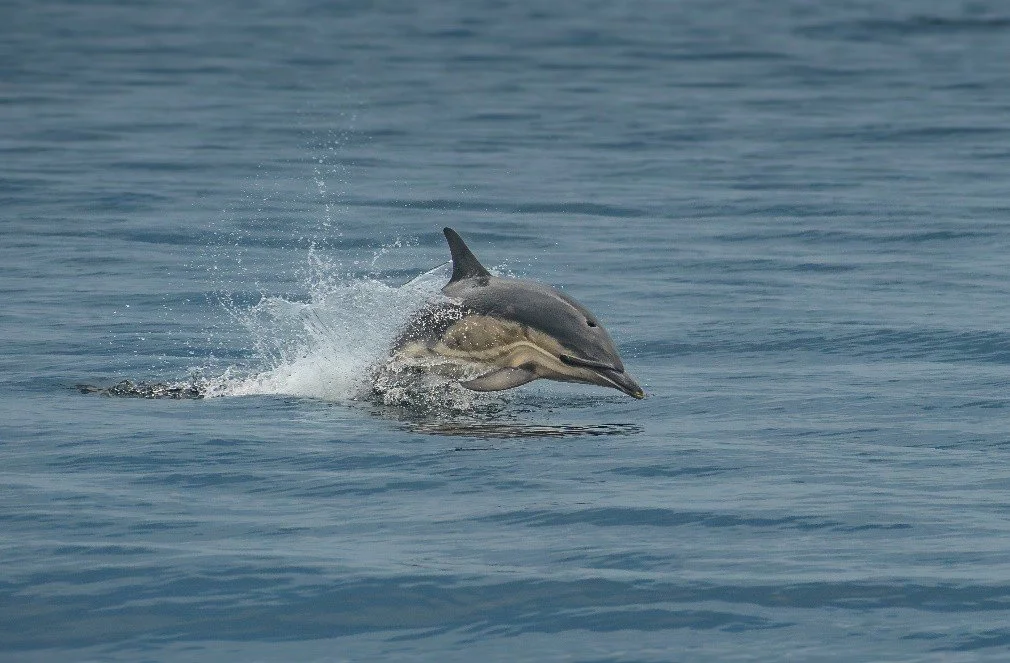
Cetaceans are a well-known and much-loved group of species, with lots of different species frequenting Irish Coasts year-round. Here, you can come across species ranging from Atlantic bottlenose dolphins and common dolphins to sperm whales and even blue whales. This month, we are looking at an overview of all of our “toothed whale” species, especially dolphins, and we will dive into some more specifically later. As you can imagine, a lot of behaviours and life cycles are similar between species. When learning about marine mammals, it is vital to be aware of threats that they face, and how you can help. This includes what to do if you find an animal stranded along the coastline, and safe practices for diving with them. You will learn all of this and more in this article.
So, What are Toothed Whales?
This group are found on the tree of life in the mammal class, in the Order Cetacea (or cetaceans), which is further subdivided into different groups. The group of species we recognise commonly as “dolphins” are, scientifically speaking, a family within the “toothed whales” or Odontocetes. They are related to “plate” or “baleen” whales, Mysticetes, what you would commonly call “whales” such as humpback whales and blue whales. Broadly speaking, these groups have evolved separately, one to hunt prey which requires teeth such as fish and squid, and filter-feeders which tend to feed on smaller organisms like plankton. When trying to decide what group you think a species fits into, this is a good rule of thumb. For example, orcas are toothed whales, and so are Odontocetes, and actually more closely related to common dolphins than they are to whales. Orcas can be seen off the west coast of Ireland, particularly during the warmer months, with Donegal bay being an excellent place to see them. Another key difference between these two groups is that the blowhole on top of the head of Odontocetes is one singular hole, whereas in Mysticetes, it is two. There are currently about 75 species of Odontocetes, and 14 species of Mysticetes. Dolphins are the largest family of Odontocetes, with beaked whales close behind. Cetacean classification is a somewhat contentious topic among scientists, with lots of species being lumped together into different groups based on their physical characteristics, for example, when genetic data may more recently suggest differently [1][2]. Cetaceans are one group of marine mammals alongside the pinnipeds (seals and sealions), the sirenians (manatees and dugongs), and more.
Behaviour
Toothed whales use echolocation to locate and hunt pray, and to visualize the world around them. Think of it like their own built-in sonar system. Echolocation in dolphins uses higher frequencies than whales, and so their sounds can’t travel over distances quite so long. An individual will generate a series of clicks or sounds from their nostrils that pass out through the front of their head through the melon, which is a fatty tissue that gives them their big forehead. Sounds bounce off of objects and prey and is reflected back in through this. Dolphins can actually change the shape of their melon, much like how a person can change the shape of the lens in our eye to focus on different distances. Through this and their excellent sight, they can build an accurate picture of what is around them – even those hiding beneath the sand.
Diets of different species vary widely, from relying on shallow-water fish species to deep-sea squid, and as with many predatory species, their distribution is heavily dependent on the availability of preferred food sources [3].
They are highly social animals, forming close bonds with each other and complex social structures. They use their clicks and whistles to communicate, varying the frequency and duration. Dolphin social structures differ for males and females. Females will often form groups together, and raise their calves, whilst males typically compete for the opportunity to mate with females in an area or will form groups themselves to do this if the groups of females are larger. This is especially important when these species can only produce a limited number of calves which take a long time to mature. Of course, these behaviours will vary between species and over time, but generally speaking, males are bigger than females [4][5].
Like mammals across the board, cetaceans as a whole tend not to reproduce very often, and when they do have only a small number of babies which take a long while to reach maturity. This can make them much more vulnerable to human impacts like overfishing.
Threats
Human activity poses a wide range of threats to these animals for a number of reasons. Overfishing can deplete food sources or hunt the species themselves, and they can get caught in nets, both in use and discarded in the ocean. Since they can control their body temperature, unlike most fish, they aren’t so immediately affected by ocean warming in the same way that other species are. But of course, you can imagine that when their prey is affected, and changes its distribution, predators will follow their pattern. Oftentimes species like the bottlenose dolphin will move between more coastal areas and offshore areas depending on where they are in their life cycle, which can change how these threats uniquely impact a species [6]. In addition to this, smaller groups tend to do better when food is scarce, and this can further alter their social behaviour [6][7].
As you can probably imagine, a cetaceans’ reliance on sound for hunting, socialising and mating make them sensitive to noise in the ocean. With the growing amount of marine traffic and offshore structures in our ocean, this affects their ability to use this sense and can result in behavioural changes like movement offshore, or stranding [8].
Cetacean Strandings
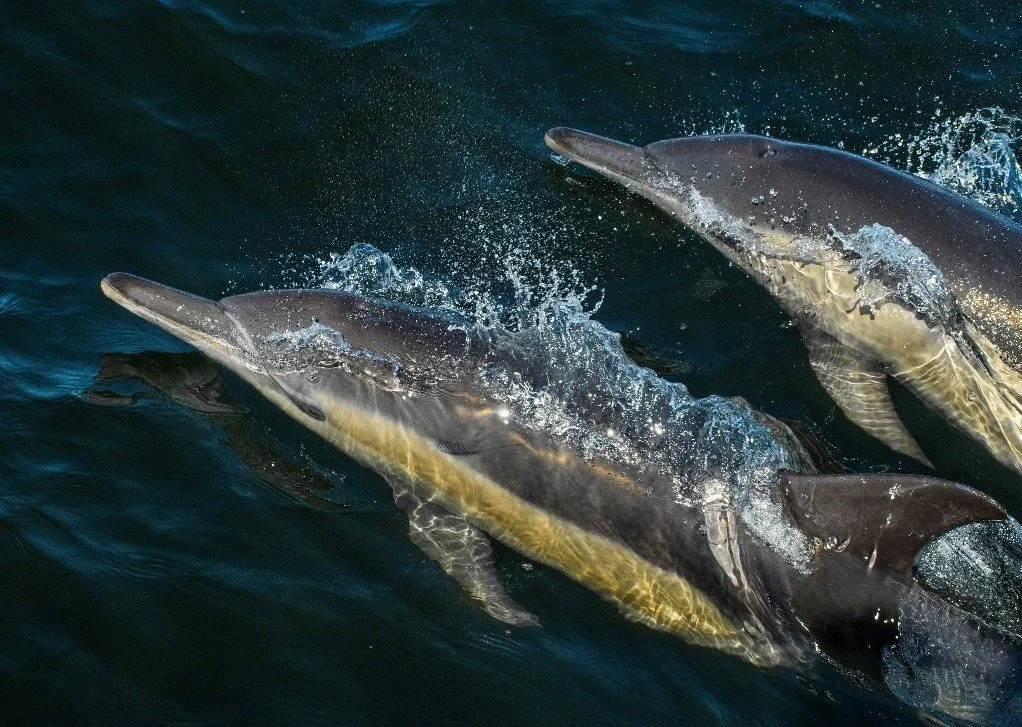
Being a PADI diver means being an advocate for local species like these. Because of this, it is important to be aware not only of responsible in-water diving with them, but also what to do if you come across an individual in distress on the shore.
Live strandings should be reported immediately to the Irish Whale and Dolphin Groups live stranding hotline at (097) 28118, and other strandings can be reported through their website. This group has members trained in handling live strandings to hopefully get any individuals safely back in the ocean, and all of the guidelines for what you can do while you wait for help.
Sightings can be reported to the Irish Whale and Dolphin Group here: https://iwdg.ie/report-a-sighting/
Responsible Diving Guidelines
Diving with cetaceans is an amazing experience, and it is important to be a safe and responsible diver while doing so. Where possible, keep your distance from them and do not touch, grab, or try to ride them (or any marine species for that matter!). Removing debris from the ocean in community-led events like beach cleanups and dive surveys is also an amazing way to help reduce the risk of things like entanglement. You can learn more about this through the PADI AWARE training, as well as getting involved with local groups.
Resources
Padi AWARE Specialty: https://store.padi.com/en-ca/courses/padi-aware-specialist/p/70552-1B2C/
Irish Whale and Dolphin Group: https://iwdg.ie/
References
Photos by Daniel Fildes; https://dfwild.com/ , @dfwild
1. Geisler, J.H., Sanders, A.E. (2003). Morphological Evidence for the Phylogeny of Cetacea. Journal of Mammalian Evolution 10, 23 - 129. https://doi.org/10.1023/A:1025552007291
2. Michael R McGowen, Georgia Tsagkogeorga, Sandra Álvarez-Carretero, Mario dos Reis, Monika Struebig, Robert Deaville, Paul D Jepson, Simon Jarman, Andrea Polanowski, Phillip A Morin, Stephen J Rossiter. (2020). Phylogenomic Resolution of the Cetacean Tree of Life Using Target Sequence Capture. Systematic Biology, Volume 69, Issue 3, May 2020, Pages 479–501, https://doi.org/10.1093/sysbio/syz068
3. Giralt Paradell, O., Díaz López, B., & Methion, S. (2019). Modelling common dolphin (Delphinus delphis) coastal distribution and habitat use: Insights for conservation. Ocean & Coastal Management, 179, 104836. https://doi.org/10.1016/j.ocecoaman.2019.104836
4. Connor, RC. (2007). Dolphin social intelligence: complex alliance relationships in bottlenose dolphins and a consideration of selective environments for extreme brain size evolution in mammals. Philos Trans R Soc Lond B Biol Sci. 2007 Apr 29;362(1480):587-602. https://doi.org/10.1098/rstb.2006.1997
5. Gowans, S., Würsig, B., & Karczmarski, L. (2007). The social structure and strategies of delphinids: Predictions based on an ecological framework. In D. W. Sims (Ed.), Advances in marine biology (Vol. 53, pp. 195–235). Elsevier Academic Press.
6. Cañadas, A., & Hammond, P. S. (2008). Abundance and habitat preferences of the short-beaked common dolphin Delphinus delphis in the southwestern Mediterranean: Implications for conservation. Endangered Species Research, 4(3), 309–331. https://doi.org/10.3354/esr00073
7. Neumann, D. R. (2001, November). The behaviour and ecology of short-beaked common dolphins (Delphinus delphis) along the east coast of Coromandel Peninsula, North Island, New Zealand: With a note on their interactions with humans: A dissertation presented in partial fulfillment of the requirements for the degree of Doctor of Philosophy in Marine Science at Massey University. https://mro.massey.ac.nz/handle/10179/4647
Di Franco, E., Pierson, P., Di Iorio, L., Calò, A., Cottalorda, J. M., Derijard, B., Di Franco, A., Galvé, A., Guibbolini, M., Lebrun, J., Micheli, F., Priouzeau, F., Risso-de Faverney, C., Rossi, F., Sabourault, C., Spennato, G., Verrando, P., & Guidetti, P. (2020). Effects of marine noise pollution on Mediterranean fishes and invertebrates: A review. Marine Pollution Bulletin, 159, 111450. https://doi.org/10.1016/j.marpolbul.2020.111450
