
Ireland’s Tubeworms
Kate McGonagle
Intro
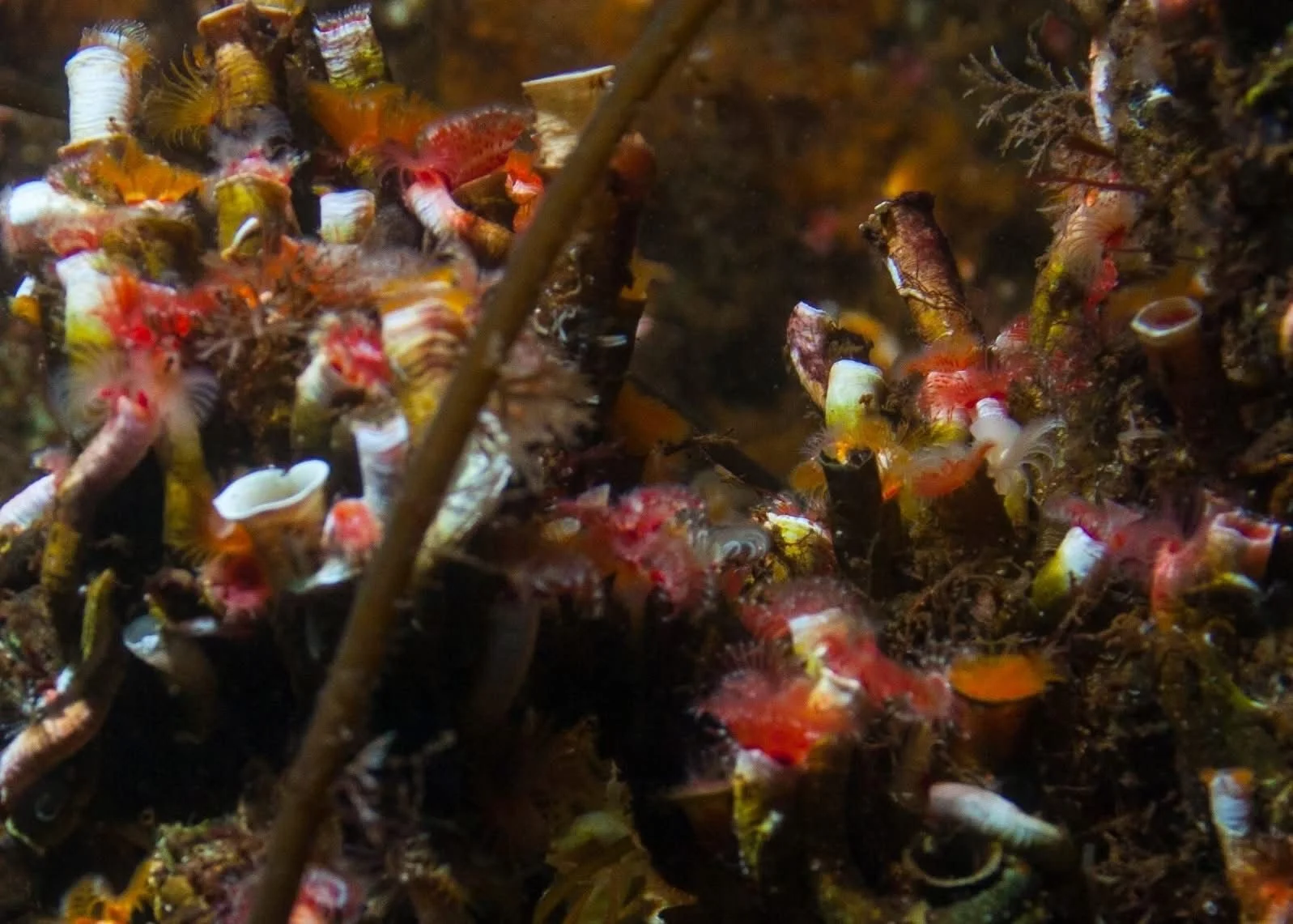
This month we’re taking a look at one at a more unusual group of species that you can encounter on a dive – tubeworms. Tubeworms are segmented worms, or polychaetes, commonly called bristle worms. This group evolved form a common ancestor, but not all of that ancestors’ descendants are actually polychaetes. Tubeworms attach themselves onto the seafloor by their tails and build their own tubes to live in. They make these tubes out of a mucus they secrete, sand, and bits of sea shells, encasing themselves inside for protection. Many tubeworms are deep-sea species that live around hydrothermal vents - cracks in the ocean floor that release nutrient-rich warmer water. The tubeworms there are not ones you encounter on scuba, but they are a hallmark species of this harsh environment. The species we encounter on dives around Ireland and beyond are coastal and estuarine species which anchor themselves in sediments like sand or mud. Across their group, they can be found worldwide.
Ecology
Tubeworms eat using their tentacles which fan out above their tubes to generate currents that carry food. Across the group, they aren’t too fussy and will take what they can get from the water column. The tubeworms found at hydrothermal vents get their food from bacteria that live in a specialised organ, and actually don’t have a digestive system. These bacteria take up nutrients coming from the vent and convert it into food for the tubeworm, getting shelter in return.
Tubeworms generally reproduce by releasing sperm and eggs into the water column, which then meet and develop into swimming larvae and settle somewhere suitable to grow into an adult. Some tubeworms can also reproduce asexually, by splitting themselves in two. A lot of different species around the world have been seen forming their colonies by a combination of the two, but this is very dependent on the species you are talking about.
Why are tubeworms so important?
Tubeworms themselves are a really vital part of the ecosystems we encounter them in, providing ecosystem services and acting as engineers of their environment. They change the sediment that they settle in, provide shelter for small creatures, and change the structure of their communities [1]. Some studies have actually shown that in areas where tubeworms are present, there is a greater diversity of species than when there is not [1]. The impact that tubeworms have on their environment is, as you can imagine, directly related to the amount of tubeworms in a given habitat [1], and so protecting these species in places we dive, like Killary Fjord and Clifden, has a direct and lasting impact on the other residents.
Tubeworms are especially important as indicators of the health of an ecosystem, because many of them are very sensitive to changes in their environment. Their growth and reproduction can be impacted by changes in salinity, temperature, and water quality. Because they can be so sensitive, changes in their environment can slow their development and reproduction. So if the tubeworms aren’t doing well, it can be an early warning sign that something more is wrong [2].
In fact, the environment a mother grows up in can affect their offspring, affecting how flexible they are in coping with stresses [3].
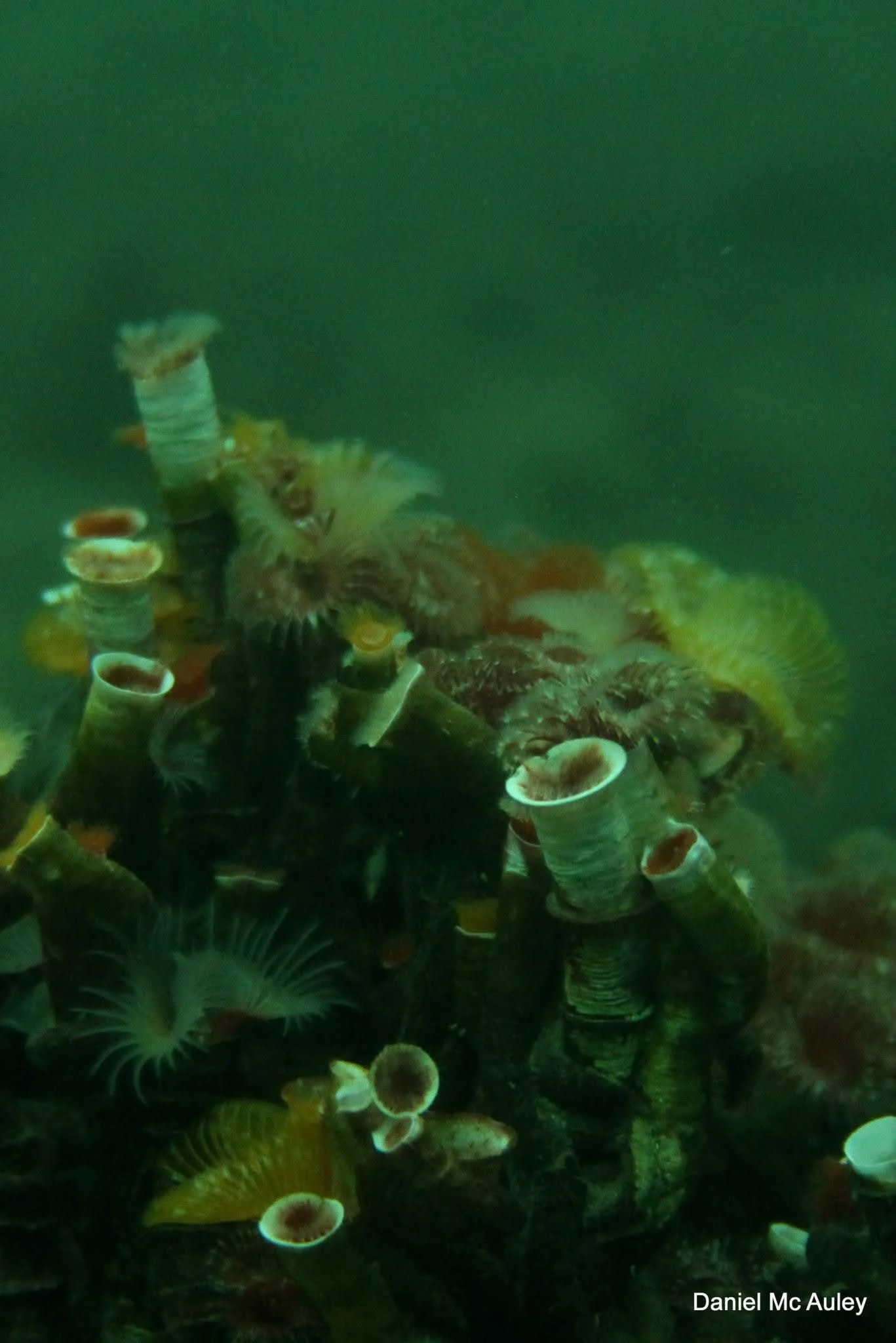
Tubeworms filter feeding in Killary Fjord (Photo by Dan McAuley)
Tubeworms on Irish Dives
Tubeworms are distributed all around our coasts, with the higher concentrations found in the west coast, making Killary Fjord and excellent dive site to see them. One species you are likely to see there is Serpula vermicularis. Less than 10cm, these worms vary in colour, with whiteish tubes and pale yellow to red bodies.
If you encounter tubeworms on your dives, make sure not to touch them and be careful of kicking up the area with your fins when passing.
References
[1] Callaway, R. (2006). Tube worms promote community change. Marine Ecology Progress Series, 308, 49–60. https://doi.org/10.3354/meps308049
[2] Jarrold, M. D., Chakravarti, L. J., Gibbin, E. M., Christen, F., Massamba-N’Siala, G., Blier, P. U., & Calosi, P. (2019). Life-history trade-offs and limitations associated with phenotypic adaptation under future ocean warming and elevated salinity. Philosophical Transactions of the Royal Society B: Biological Sciences, 374(1768), 20180428. https://doi.org/10.1098/rstb.2018.0428
[3] Massamba-N’Siala, G., Prevedelli, D., & Simonini, R. (2014). Trans-generational plasticity in physiological thermal tolerance is modulated by maternal pre-reproductive environment in the polychaete Ophryotrocha labronica. Journal of Experimental Biology, jeb.094474. https://doi.org/10.1242/jeb.094474
