
Ireland’s Resident Star-Studded Shark – The Starry Smooth Hound
Introduction
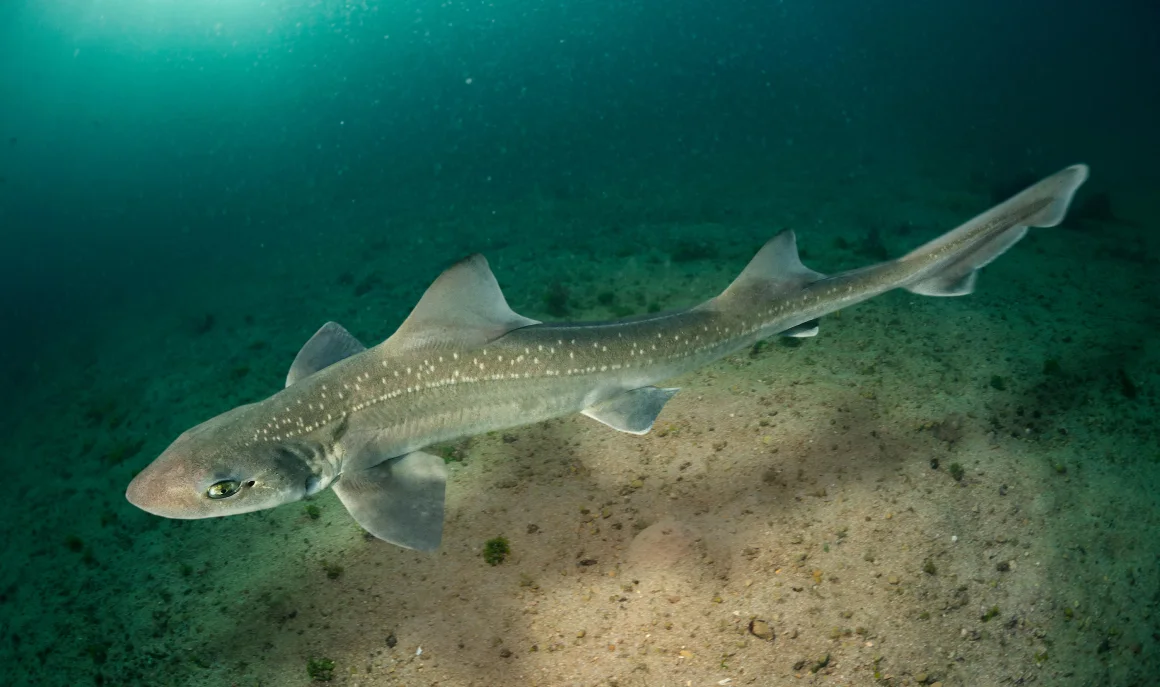
This month we are taking a look at a species of shark that I personally find really interesting – the illusive starry smooth hound. This species is definitely one of our lesser-known smaller sharks that are found around our coasts, and up until quite recently it was even thought that there were two different species in our waters, common and starry. More recent study has found that actually, all of our smooth hounds are starry smooth hounds. Starry smooth hounds get their name from their smooth grey appearance, dotted with small white “stars” on the top of their bodies. They can be much more skittish than the catsharks we commonly encounter on our dives, but they are common enough around the Irish coast, and if you’re lucky you might catch a glimpse of one.
What Are They, and What do They Look Like?
Starry smooth hounds, scientifically named Mustelus asterias, are a medium-sized shark, found in the Northeast Atlantic, from the North Sea to the Mediterranean [1]. They are characterised by pointed head and slim body, with relatively large fins, and look like a sort of quintessential “sharky” shark.
Because the two species of smooth hounds look quite similar, it has been recent genetic studies that have concluded that only starry smooth hounds are present in Irish and UK waters, and this alone makes fishing records going back further somewhat unreliable in their reporting of the two species [1]. While the “stars” on their bodies is a hallmark characteristic, they are not always present and this has confused identification in the past. The females are generally a bit bigger than the males, but either way if you encounter one they probably aren’t going to be bigger than about one metre [1].
They belong to the Carchariniformes, the largest group of sharks, which includes other common sharks like catsharks. Smooth hounds specifically are found in the Triakidae family, or houndsharks, with around 40 other species [2].
The Life of a Smooth Hound
These guys are a comparatively understudied shark, with some research coming out in the last ten years around their reproduction and life histories. Starry smooth hounds develop and give birth to live pups, rather than laying eggs. Pups develop inside the mother, getting their nutrients from a yolk sack while they are growing [3]. Like all sharks, starry smooth hounds are more vulnerable to overfishing and other threats due to their longer life cycles – they take longer to reach sexual maturity, their young take longer to develop, and they generally produce a small number of offspring.
Their diet predominantly consists of crustaceans. One study found that the two most important species for them were the hermit crab and the flying crab [4]. I find this particularly interesting - when I was recently on a survey in Youghal, Co.Cork, we tagged and released about 25 starry smooth hounds in one go, and our samples were also dominated by large numbers of hermit crabs.
Where Are They?
While we need a lot more research into their movements, we do know that they live close to the sea floor, with their habitat use changing seasonally and daily. They also seem to prefer deeper water and stick closer to the seabed during the daytime, moving a bit more and in shallower water at night [5].
The best bet for encountering these sharks on a dive is in the summer months around the east coast. We definitely need more research on their migration patterns and distribution around our coasts, but they are present in good numbers around Wexford and Wicklow during the warmer months of the year, and are definitely present to some degree around Dublin then too. One study in 2013 even documented a group of starry smooth hounds in Rogerstown Estuary in Dublin. They were thought to be in the estuary possibly looking for food, before they were rescued from a shrinking tide pool [6]. The abundance of the species around the rest of our coasts is definitely lower, but with so little data it is hard to know how much of that is simply a lack of effort in recording them.
Either way, if you are lucky enough to spot one of these mysterious sharks on a dive in Dublin or beyond, it is definitely your lucky day.
References
1. McCully Phillips, S. R., & Ellis, J. R. (2015). Reproductive characteristics and life‐history relationships of starry smooth‐hound Mustelus asterias in British waters. Journal of Fish Biology, 87(6), 1411–1433. https://doi.org/10.1111/jfb.12826
2. Vossen, K., McCully Phillips, S., Wellcome Sanger Institute Tree of Life Management, Samples and Laboratory team, Wellcome Sanger Institute Scientific Operations: Sequencing Operations, Wellcome Sanger Institute Tree of Life Core Informatics team, Tree of Life Core Informatics collective, & Darwin Tree of Life Consortium. (2025). The genome sequence of the Starry smooth-hound, Mustelus asterias Cloquet, 1819 (Carcharhiniformes: Triakidae). Wellcome Open Research, 10, 500. https://doi.org/10.12688/wellcomeopenres.24796.1
3. Capapé, C. (1983). Nouvelles données sur la biologie de la reproduction de Mustelus asterias Cloquet, 1821 (Pisces, Pleurotremata, Triakidae) des côtes Tunisiennes. Vie et Milieu 33,143–152.
4. McCully Phillips, S. R., Grant, A., & Ellis, J. R. (2020). Diet composition of starry smooth-hound Mustelus asterias and methodological considerations for assessing the trophic level of predatory fish. Journal of Fish Biology, 96(3), 590–600. https://doi.org/10.1111/jfb.14245
5. Griffiths, C. A., Wright, S. R., Silva, J. F., Ellis, J. R., Righton, D. A., & Phillips, S. R. M. (2020). Horizontal and vertical movements of starry smooth-hound Mustelus asterias in the northeast Atlantic. PLOS ONE, 15(10), e0239480. https://doi.org/10.1371/journal.pone.0239480
6. Quigley, D. T. G. (2016). Smooth-hound Shark (Mustelus asterias Cloquet, 1819): Live strandings in Irish and UK estuarine waters. The Irish Naturalists’ Journal, 35(1), 27–34.
