
Introduction
Previously, we took a look at Dolphins and their relatives, and this time we are diving into the other major group of cetaceans – the “baleen” or “plate” whales. This group of cetaceans frequents Ireland’s West Coast each year, particularly during the summer months, with opportunities to see these incredible animals for yourself from places like Donegal Bay. This article discusses the classification of whales, species you can find in Ireland, whale behaviour, threats, and how to be an advocate for these incredible animals.
So, What are Baleen or Plate Whales?
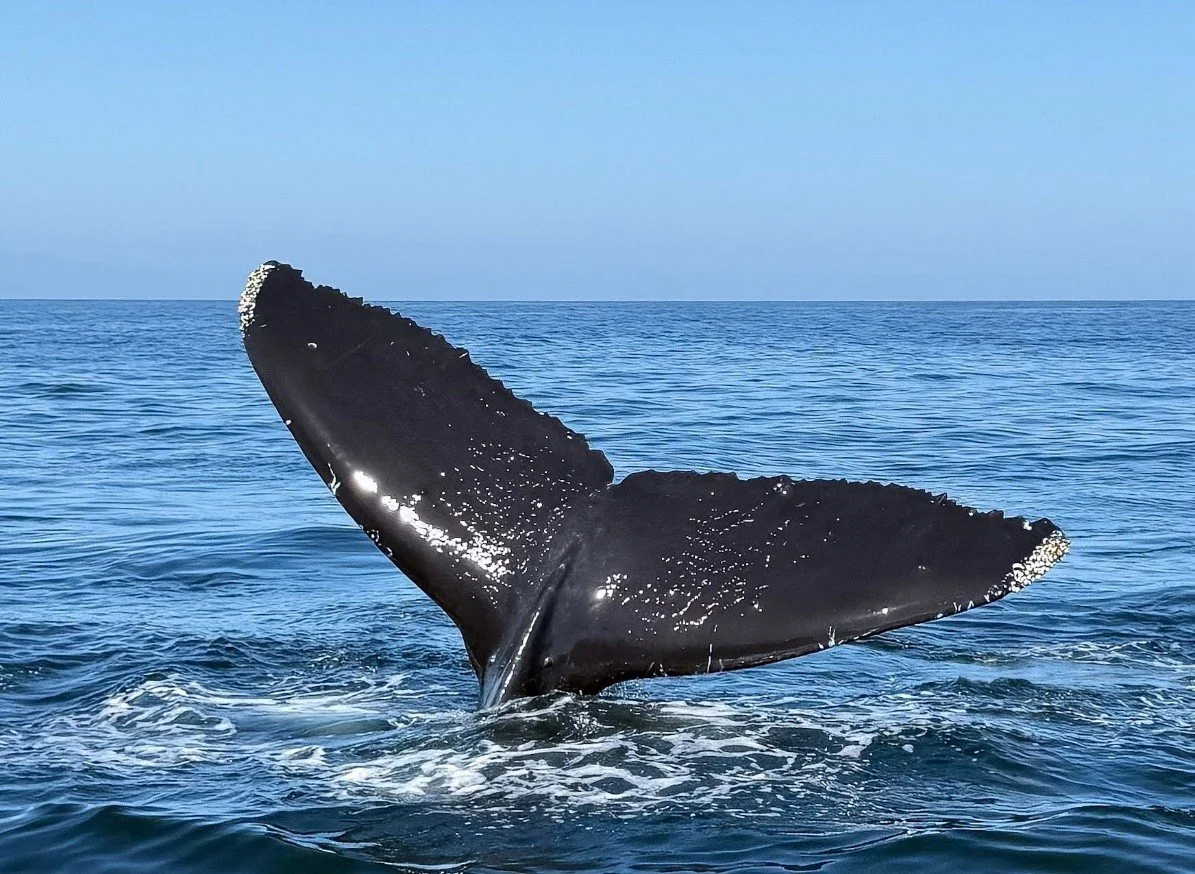
Like the toothed whales, baleen whales are found in the mammal class on the tree of life, in the Order Cetacea. The group of species we would commonly call whales are technically a parvorder of the mammals called the Mysticetes, or baleen whales. The other group found here are the Odontocetes, or “toothed whales”, where dolphins and their relatives are classified. The mysticetes can be distinguished physically from these by their baleen plates in their mouths – made up keratin, the same protein that makes up human hair and nails. These act similarly as hairs in whales, used to filter small organisms like plankton and krill from the water they take in. The blowhole of a Mysticete resembles nostrils, divided into two, whilst in Odontocetes it is a singular hole. There are far less species of Mysticetes, and currently about 15 are described. There are four families of baleen whales - the Balaenidae, Balaenopteridae (the rorquals), Eschrichtiidae (the gray whale), and the family Neobalaenidae (the pygmy right whale). Four species make up the family Balaenidae: the bowhead whale, and the right whales. The Balaenopteridae is the largest family with nine species including the blue whale and the humpback whale.
Many of these species can be seen around our coasts including bowhead whales, fin whales, blue whales, humpack whales, and sei whales. Many of these species are migratory, travelling great distances to mate and feed, and can be seen travelling up our coasts at particular times of the year.
Behaviour
Similar to the odontocetes, baleen whales use echolocation to navigate their environment, communicate, and locate prey. An individual will generate a singular sound or stream of sounds, varying in frequency, which will travel through the water column and reflect back to them. Baleen whales use a wider range of frequencies than odontocetes, and much of their sounds can travel much further, allowing them to communicate with or “sing” to each other over great distances.
All types of cetaceans have been documented playing in the ocean, much like we do. Whales have been seen playing with objects like logs and rope, as well other species like jellyfish and sea turtles [1]. There has also been research into interactions between dolphins and whales, in particular bottlenose dolphins, where they may search for food together, or play together [1]. Dolphins often come up to boats and ride the waves created at the front as you may have seen, and this is no different to how they sometimes play in the waves created by a whale’s head when swimming. Despite whales having such long lifespans and being able to communicate over long distances, they seem to have more simple social structures than their toothed relatives [2]. They typically tend to be solitary when not mating, or are found in pairs with their calves, although they do interact with each other in some similar ways to dolphins, like coming together cooperatively to feed [2].
Mysticetes store food in the form of blubber from feeding grounds at high latitudes, before moving to lower latitudes to breed, where they will use this stored food to support their reproduction, unlike lots of other mammals, which feed throughout the process to make sure they have enough energy [3]. Whales engage in courtship behaviours during the mating season, “dancing” with each other in the water before mating [4].
Threats
Noise pollution presents a significant threat to baleen whales due to their reliance on sound to communicate and navigate. As these species tend to use this sixth sense over greater distances, they are heavily impacted by noise from marine traffic and offshore drilling, and sometimes because of this can beach or strand on shore.
As is typical of mammal species, whales have long lifespans, take a long while to reach maturity, stay with their offspring for a long time, and have a very small number of calves at a time (usually just one). These traits do make them more vulnerable to whaling and the whale meat industry, as one whale being taken also takes the numerous future calves they could have had, their calves’ calves, and so on. In ecology, ecosystems can be described to be regulated from the bottom of the food chain up, i.e. by the amount of food, which limits the number of predators, or from the top of the food chain, i.e. by the number of predators controlling prey populations. In general, whales depend on there being enough prey available to them, and this is why they can be so affected by overfishing, although can also have effects on the food chain top-down [5].
Of course, fishing whales themselves, or whaling, can pose threats to populations of all kinds of cetaceans in places like Antarctica and the Faroe Islands, where these practices are still legal.
Cetacean Strandings
Being a PADI diver means being an advocate for local species like these. Because of this, it is important to be aware not only of responsible in-water diving with them, but also what to do if you come across an individual in distress on the shore.
Live strandings should be reported immediately to the Irish Whale and Dolphin Groups live stranding hotline at (097) 28118, and other strandings can be reported through their website. This group has members trained in handling live strandings to hopefully get any individuals safely back in the ocean, and all of the guidelines for what you can do while you wait for help.
Sightings can be reported to the Irish Whale and Dolphin Group here: https://iwdg.ie/report-a-sighting/
Responsible Diving Guidelines
Diving with cetaceans is an amazing experience, and it is important to be a safe and responsible diver while doing so. Where possible, keep your distance from them and do not touch, grab, or try to ride them (or any marine species for that matter!). Removing debris from the ocean in community-led events like beach cleanups and dive surveys is also an amazing way to help reduce the risk of things like entanglement. You can learn more about this through the PADI AWARE training, as well as getting involved with local groups.
Resources
Padi AWARE Specialty: https://store.padi.com/en-ca/courses/padi-aware-specialist/p/70552-1B2C/
Irish Whale and Dolphin Group: https://iwdg.ie/
References
Photos by Daniel Fildes; https://dfwild.com/ , @dfwild
1. Meynecke, J., Crawley, O. (2025). Assessing social behaviour between baleen whales (Mysticeti) and dolphins (Delphinidae). https://doi.org/10.1007/s44338-025-00099-2
2. Valsecchi, E., Hale, P., Corkeron, P., Amos, W. (2002). Social structure in migrating humpback whales (Megaptera novaeangliae). https://doi.org/10.1046/j.0962-1083.2001.01459.x
3. Christiansen, F., Vikingsson, G.A., Rasmussen, M.H., Lusseau, D. (2014). Female body condition affects foetal growth in capital breeding mysticete. https://doi.org/10.1111/1365-2435.12200
4. Lockyer, C. (1984). Review of Baleen Whale (Mysticeti) Reproduction and Implications for Management. https://www.researchgate.net/publication/282383861_Review_of_Baleen_Whale_Mysticeti_Reproduction_and_Implications_for_Management
5. Szymon Surma and Tony J. Pitcher. (2015). Predicting the effects of whale population recovery on Northeast Pacific food webs and fisheries: an ecosystem modelling approach. Fisheries Oceanography, 24: 291–305.
